
The Sega and Nintendo rivalry is often remembered as loud, sharp, and full of attitude. For players who grew up in the 1980s and 1990s, it was more than a sales fight. It was playground debate, magazine drama, and bold advertising wrapped around two very different ideas of what console gaming could be. That is why a small letter between two executives feels so striking today.
Retro Context
During the 16-bit years, Sega and Nintendo competed in public for control of the video game market. Sega pushed hard against Nintendo’s position, and both companies traded shots through marketing and press coverage. Tom Kalinske, then leading Sega of America, became one of the best-known figures in that fight. Across the aisle was Howard Lincoln, president of Nintendo of America, a rival in one of gaming’s most documented business battles.
That period later became the basis for the 2014 book Console Wars and a 2020 documentary film co-directed by Jonah Tulis and Blake J. Harris, the author of the book. The story has usually been told through competition: market share, aggressive campaigns, and the cultural split between fans. The letter adds a quieter final note, showing that the people behind the rivalry could still recognize one another’s work once the battle cooled.

Why It Matters
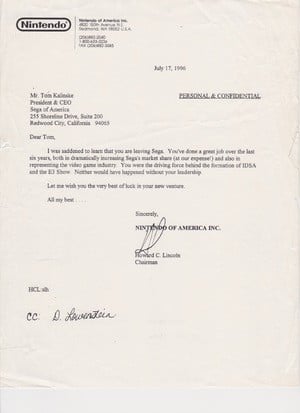
Kalinske had mentioned in a 2022 interview that Lincoln sent him a kind letter after Kalinske announced he was leaving Sega. Kalinske said he valued the note and still kept it in his office. A copy was later shared for publication, with Harris providing an original scan said to have not been published before. For retro readers, that detail matters because it turns a familiar corporate rivalry into something more human and specific.
In the letter, Lincoln said he was sad to hear Kalinske was leaving Sega and credited him with doing strong work over six years. He acknowledged that Sega’s market share had grown dramatically, even though that growth came at Nintendo’s expense. More importantly, Lincoln also praised Kalinske’s role in representing the broader video game business rather than only Sega’s interests.
What Lincoln Credited Kalinske With
- Helping Sega grow its market share during his six years at the company.
- Playing a major role in the formation of the Interactive Digital Software Association.
- Helping make the E3 show happen through his leadership.
- Representing the wider video game industry, not just Sega.
The most surprising part is Lincoln’s view of Kalinske’s industry work. He described Kalinske as the driving force behind both the Interactive Digital Software Association and E3. The IDSA later became the ESA, while E3 went on to become one of the most important annual events in the games calendar. That makes the note more than a polite farewell. It points to Kalinske’s influence beyond the console war itself.
Harris has said that when Kalinske first told him about the letter, he wondered if the story might have been exaggerated because the Sega and Nintendo rivalry had been so fierce and personal. Seeing the actual letter changed that. For Harris, Lincoln’s respectful tone and direct praise made the note feel like the right closing moment for the Console Wars story.
Z-retro View
The letter does not erase the rough edges of the Sega versus Nintendo years, and it should not be treated as if the rivalry was only friendly theater. The competition was real, and it helped shape how players remember the 16-bit era. Still, Lincoln’s message to Kalinske gives the story a useful ending: two rivals could fight hard in public, then step back and acknowledge the work that moved the whole industry forward.