The Anbernic RG Vita Pro has a name that invites the wrong first question. A handheld called Vita Pro sounds like it might be a modern way to replace Sony’s PlayStation Vita, but that is not what this device is. The better way to judge it is as a widescreen retro handheld that borrows some of the Vita’s look while aiming at a different job. Based on Time Extension’s review, its strongest appeal is not Vita emulation. It is PSP play, general handheld emulation, a clean all-glass front, and a feature set that could become more interesting as community software improves.
Retro Context
The PlayStation Vita still matters to retro handheld fans because it helped define the modern portable shape. It was not a commercial success, but its wide candybar body, dual analog sticks, glassy front, and more mature feel made it look closer to later handheld trends than many older pocket systems. The Nintendo 3DS had its own strengths and identity, but the Vita presented a different idea: a portable machine that felt more like a sleek personal device than a toy-like games console.
That history is why the RG Vita Pro name carries weight. Retro players are often looking for convenient ways to revisit libraries without relying only on aging original hardware, and the Vita itself has become a preservation headache for anyone who wants a simple, modern replacement. The RG Vita Pro does not solve that problem. It cannot play most of the Vita catalogue well enough to be treated as a substitute. Instead, it belongs to the newer wave of emulation handhelds where community firmware, emulator maturity, and careful setup can matter almost as much as the shell and screen.
Why It Matters
The practical value of the RG Vita Pro depends on what the buyer expects from it. If the goal is to keep playing actual Vita games, the safer answer remains an original PlayStation Vita. Time Extension’s review is clear that Vita performance is not dependable: lighter games may run for a time, but crashes can still happen, and the Vita3K emulator is not as mature as many older-system emulators. That caveat is important because the name creates expectations the hardware and software ecosystem cannot fully meet right now.
Where The RG Vita Pro Makes More Sense
- PSP is the highlight, with tested games running smoothly at 3x upscaling and many working at 4x upscaling.
- The widescreen format suits systems that do not feel ideal on smaller 4:3-focused handhelds.
- Battery life is strong for PSP play, with roughly five hours reported from one charge.
- Charging was reported as quicker than the usual Anbernic pace, moving from 10% to 90% in around 70 minutes.
- Video output through USB-C and micro HDMI gives it extra use on a larger screen, which is still unusual around this price level.
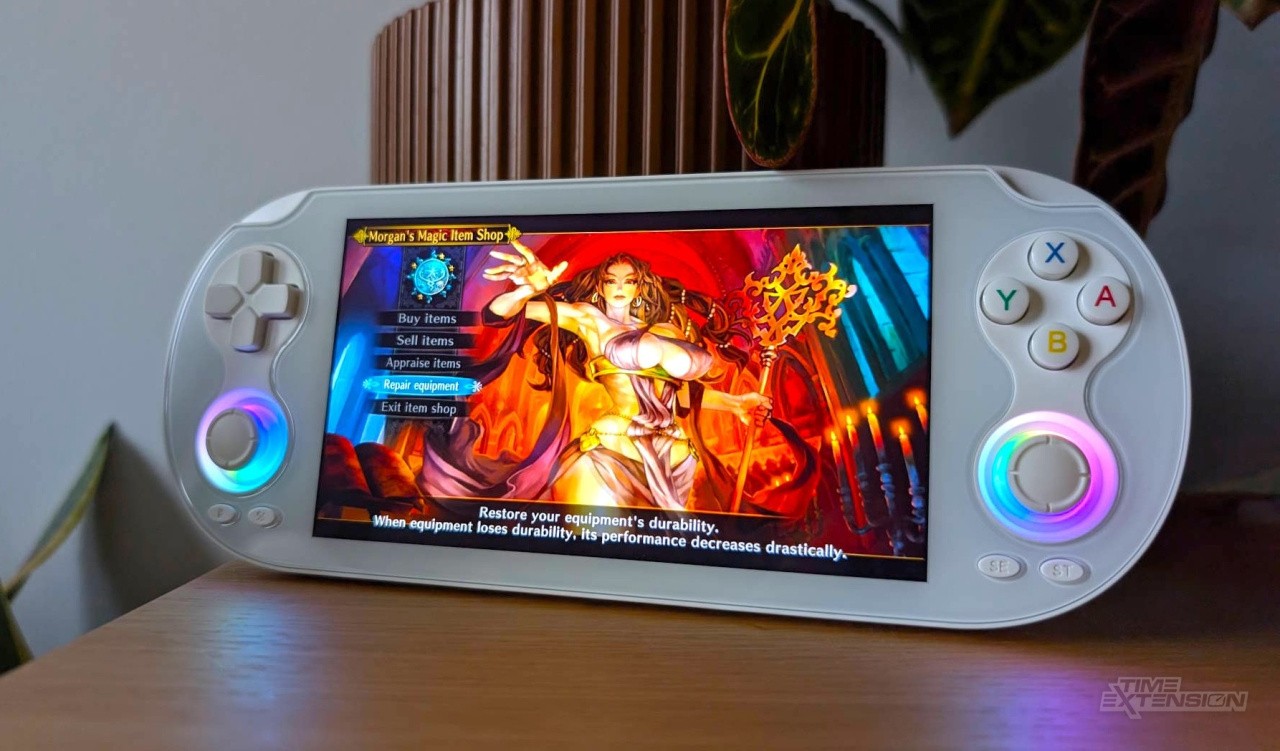
As a physical device, the RG Vita Pro seems to understand the appeal of the Vita shape without copying every detail. The flat body is described as surprisingly comfortable even without real ergonomic bumps, and the rear divots are decorative rather than functional. The glass front gives it a more premium feel than the $150 price might suggest, although it also brings the obvious caution that this is not a handheld anyone will want to drop. The overall impression is less about luxury and more about a clean, modern pocket-console feel.
The controls sound like familiar Anbernic territory. The D-pad uses a soft membrane, so it will not satisfy players who specifically want the clicky feel of the original Vita’s D-pad. The face buttons have Nintendo-style ABXY labels, likely because PlayStation’s shape icons are protected branding, and they are described as having a comfortable amount of resistance. The weaker point is the shoulder area. The digital shoulder buttons and triggers are a good size, but they are also very clicky, which can become annoying in quiet rooms or late-night play.
Software is another mixed but manageable part of the story. The two microSD card slots support dual booting between Linux and Android 14. The default Linux side is functional and launches games quickly, but the interface is plain and gives the impression that Anbernic still has work to do on its own operating system experience. The better news is that the device is not presented as a blank project for experts only. Emulators are pre-installed, and much of the basic setup is already handled. Some users may still need to point an emulator toward game folders or BIOS files, but the starting point is not unusually hostile.
Inside, the RG Vita Pro uses the RockChip RK3576 with 4GB of RAM, and Time Extension notes that it is the first gaming handheld to ship with that chip. The performance picture is lower-mid-range rather than high-end. Benchmarks put it above some budget devices such as the Mangmi Air X, but below Anbernic’s T820-based handhelds, including the RG Slide and RG 476H. That matters because the $150 price places it near stronger options. A device like the Retroid Pocket 5 is described as sitting roughly $50 higher while offering more power and an OLED screen, so the RG Vita Pro has to win on shape, PSP fit, features, or future software rather than raw value alone.
Z-retro View
The fair reading is that the RG Vita Pro is a promising handheld with a slightly risky name. The Vita-style design helps it stand out, but it also points buyers toward the one expectation it cannot satisfy: reliable Vita replacement. Judged instead as a PSP-friendly widescreen machine, it becomes much easier to understand. It has a comfortable shell, good core controls, strong battery results, useful video output, and enough performance for the systems it handles best. The issue is not that the device lacks purpose. The issue is that its best purpose is narrower than the branding suggests.
For retro readers, the most useful advice is to separate nostalgia from the actual use case. Players who mainly want PSP, lighter handheld emulation, Android flexibility, and a clean widescreen form may find the RG Vita Pro appealing. Players who want Vita games, stronger PS2 or GameCube coverage, or the best performance per dollar should be more cautious. The handheld may also age better if custom firmware arrives and improves the interface, which has happened with other Anbernic devices. For now, it is a good example of the current retro handheld market: capable, interesting, and full of trade-offs that matter more than the name on the box.