
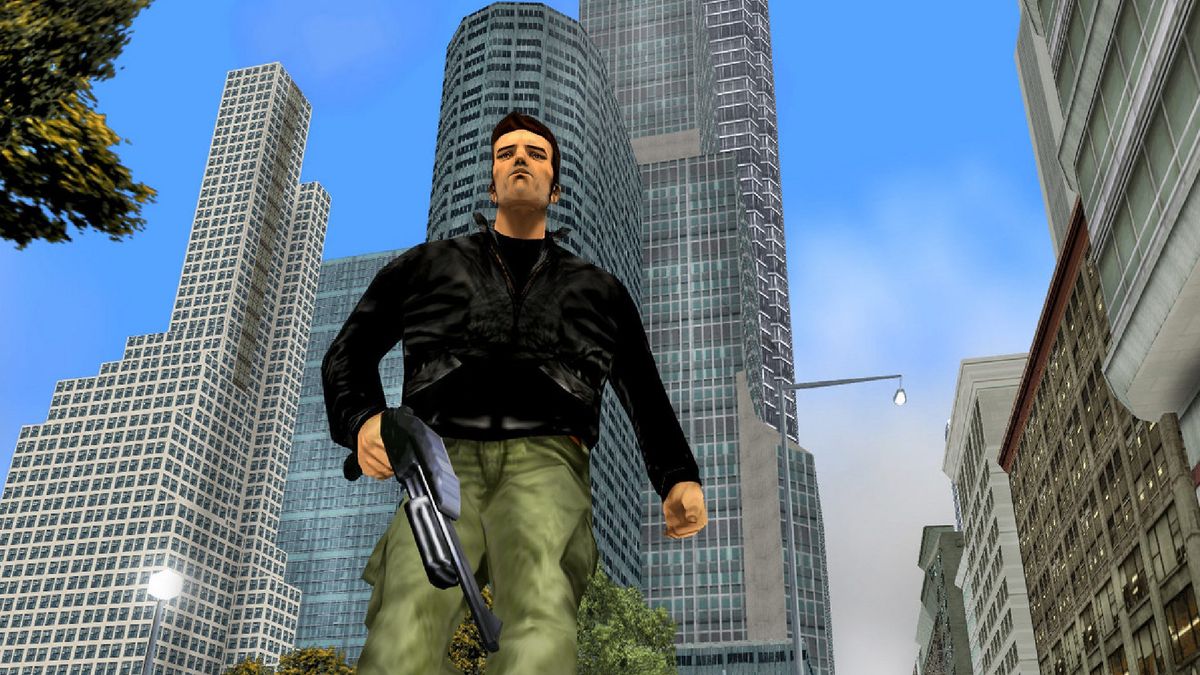
Grand Theft Auto 3 was not the first open-world game, but it helped make the modern city sandbox feel like a realistic target for console games. Liberty City seemed large, dense, and continuous at a time when the PlayStation 2 had very little memory by modern standards. A GamesRadar Retro Gamer report highlights a recent Mark Brown video that makes the trick easier to understand: the city did not all live in memory at once. The game kept only the useful parts close enough to the player, then changed that set as the player moved.
Retro Context
For a retro reader, the important point is not just that GTA 3 was ambitious. It is that its ambition had to fit inside a machine with fixed limits. The PlayStation 2 had 32MB of memory to work with, while Brown explains that the assets making up Liberty City came to around 130MB of data. Those two numbers explain the whole problem in plain terms. The city was far larger than the space available for it, so the developers needed a way to make a limited machine feel as though it was holding a much bigger world.
Rockstar North, still known then as DMA Design, solved part of that problem through structure. Liberty City was divided into three islands, and each island could be loaded separately. That helped reduce the burden, but it did not solve everything. Even the opening island, Portland, still contained more city data than the console could simply keep ready at all times. The answer had to be more flexible than a simple island-by-island split.
The Moving Window
The deeper solution was streaming. Brown describes Liberty City as being split into thousands of small sectors. As the player moved, the game loaded the assets needed for nearby sectors and removed assets that were no longer useful behind or around the player. In simple language, the city followed the player. Instead of asking the PS2 to remember everything, GTA 3 kept a changing window of useful world data in memory.
That idea sounds clean when explained after the fact, but it had to feel invisible during play. If a player was driving through streets, turning corners, or moving quickly across Portland, the illusion depended on the city seeming present before the player consciously noticed the system at work. The clever part was not only loading and unloading data. It was doing so while preserving the feeling that Liberty City was a complete place rather than a set of pieces being swapped in and out.
Making The Trick Visible
Brown's Game Maker's Toolkit video is useful because it turns that hidden process into a visible one. According to the report, he worked from GTA 3 source code, rewrote several sections of the program, and compiled a new executable. That modified version shows the loading system more openly, so viewers can see how the game builds enough of the city in front of the player and clears away what is no longer needed. It is the kind of demonstration that makes an old technical achievement easier to appreciate without needing to read the original code.
The source also makes an important caveat clear: this is still a simplified view. Streaming a city is not just a matter of drawing a boundary around the player and loading whatever falls inside it. A system like this has to handle timing, travel speed, visibility, and the player's expectation that the world will not break the moment they move in an unexpected direction. The broad concept is easy to describe. The value of the demonstration is that it shows why the concept was hard to make feel natural on real hardware.
Why It Matters
This matters because it explains why GTA 3 felt bigger than the PlayStation 2 should have allowed. The game was not relying on one magic feature. It was using a set of practical compromises, including the city split, sector loading, and lower-detail versions of assets for distant scenery. Those simpler distant versions helped reduce the shock of pop-in, because the player could see a rough version of the world before the full-detail model was needed up close.
For players, the value is also historical. Many older games are remembered through their missions, characters, and atmosphere, but technical systems shape those memories too. GTA 3's Liberty City worked because the machine was constantly deciding what the player needed to see right now. Retro preservation and technical analysis help reveal that design layer. They show that the feeling of a living city was built from careful limits, not from limitless hardware.
There is also a useful caveat for modern readers. Some of the methods discussed around GTA 3 were not completely new or unique to this one game. Streaming, level-of-detail swaps, and selective loading are broad ideas that appeared in different forms across game development. What made GTA 3 stand out was the way those ideas supported a city that became hugely influential. The lesson is not that Rockstar invented every trick. It is that the studio combined them into a convincing whole at a scale that made other developers and players pay attention.
Z-retro View
Z-retro's view is that GTA 3 remains worth studying because its achievement is easy to misunderstand. The headline version is that Rockstar fit a city onto a PS2. The more useful version is that Rockstar avoided needing to fit the whole city into memory at once. That distinction makes the game more impressive, not less, because it shows the design discipline behind the illusion.
Brown's experiment gives retro fans a better way to talk about that achievement. It strips away some of the mystery without reducing the craft. Liberty City worked because the player usually did not have to think about sectors, memory, or asset swaps. Looking back now, the hidden machinery is part of the appeal. It reminds us that many classic console games were not just products of imagination, but of careful engineering under pressure.