MiSTer FPGA users have a few interesting updates to look over, and the biggest everyday change may be Zaparoo's new launcher. It is built to give the MiSTer a more polished way to browse games, with a presentation that feels closer to a modern front end while still serving classic hardware fans.
Zaparoo Launcher Arrives
The launcher adds a cleaner graphical interface for moving through games and systems. One of its most welcome touches is artwork support, so your library can show media instead of feeling like a plain file list. That small visual upgrade can make a MiSTer setup feel more inviting, especially on a living room display.
There is one important setup note: media scraping needs to be handled on a computer first. The launcher itself is also still in beta, so it should be treated as an active work in progress rather than a finished replacement for every setup. Planned additions include search, filtering, CRT support, and more features later on.
City Connection Core Progress
A core for Jaleco's 1985 arcade game City Connection is now in development. It comes from the same creator behind the Darius 1 and Darius 2 cores, which makes it one to watch for arcade-minded MiSTer owners.
The development work has already involved some deep digging. To fix a pixel position bug, the developer spent days disassembling the original 6809 ROM. The issue was eventually resolved with help from a YouTube video showing the real arcade PCB, posted by @Janet-vc2. The City Connection core can be downloaded from the MiSTerFPGA forums.
City Connection itself is a car-based arcade platformer. The goal is to drive over elevated platforms, changing them from white to green. Once every platform on the screen has turned green, the player moves on to the next stage.
RetroAchievements And NES Video
MiSTer users who play with Retroachievement cores may also want to check out a RetroAchievements Viewer for MiSTer. Anime0t4ku shared the tool on social media, and it can be obtained through Update All. Support for MiSTer Companion is also expected soon.
There is also an alternate NES core from Mike Simone that takes a different approach to video. Instead of starting with a clean RGB source and sending it through the NTSC encoder like the official core, this version generates composite video directly from the PPU, aiming to behave more like the original hardware path.
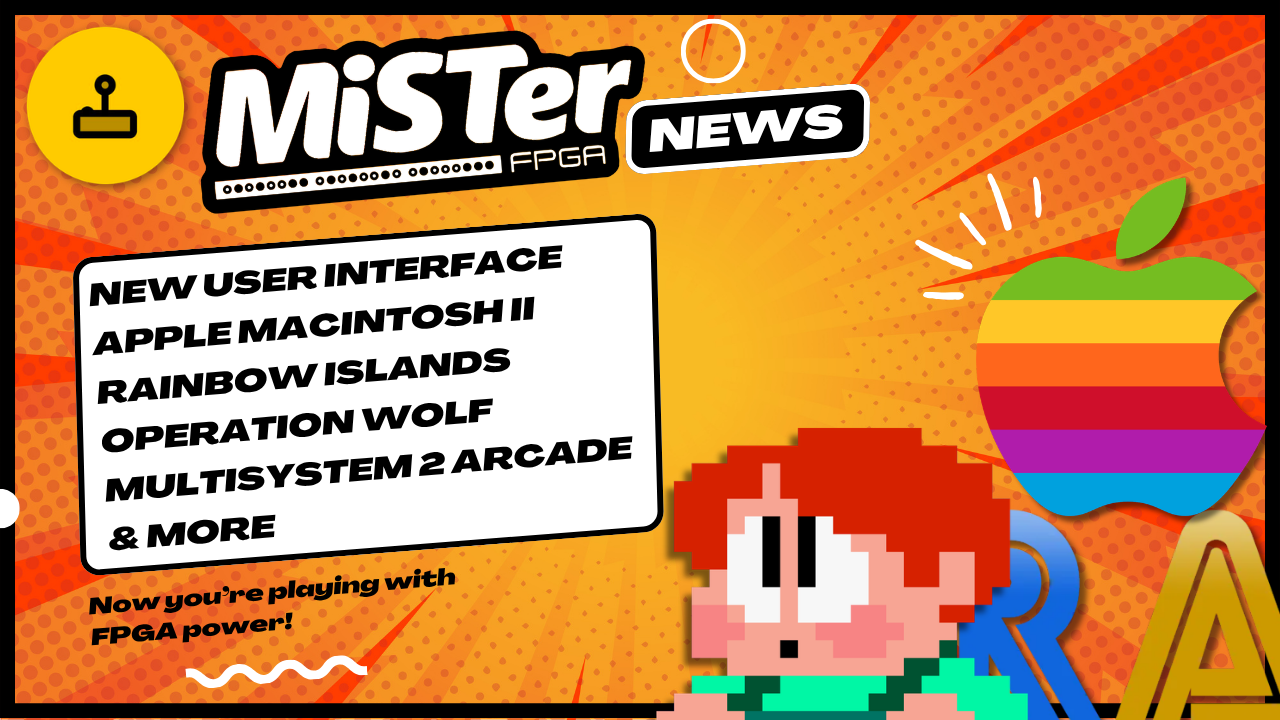
Another early project comes from developer danifunker, who is working on an Apple Macintosh II core. At this stage, it only has partial CPU and sound functions. A Discord video shows garbled graphics along with the startup sound. The original Macintosh II was sold by Apple from March 1987 to January 1990, used a Motorola 68020 32-bit CPU, and was the first Macintosh able to display color graphics.
Z-retro's view: these updates show the MiSTer scene moving in a practical direction, mixing nicer daily-use tools with careful hardware-minded core work. Some pieces are still early, but the progress is useful for anyone who enjoys classic systems with a bit of modern comfort.